Science is a craft. But we often don’t value the craft but only the product: finished articles published in journals.
This might be because most of the craft happens in places that never show up in papers: the reasons why a “simple” measurement fails, the tiny protocol changes during pilot testing that suddenly make data interpretable and the hypotheses you quietly discard after one pilot. Uncertainty and failure are vital parts of science but they tend to get swept under the rug.
This blog is my attempt to make that invisible work more visible – for others and for my future self.
It will be a collection of short, concrete notes from the world of integrative human exercise physiology. I’ll share methods that are easy to get wrong and how I’m trying to get them right. I’ll also try to talk about the mechanistic framing of what we think we’re seeing during exercise, environmental stress and other conditions. And I’ll share my best practices regarding reproducible workflows for analysis and reporting – both to help others to improve their work and to invite feedback that improves mine.
My main interest lies in integrative cardiovascular and metabolic regulation. Especially in situations where physiology doesn’t behave “as expected” – for example when central and peripheral regulation don’t align neatly, and where regulation looks more like negotiation than a clean control system. And honestly, I really enjoy racking my brain about human physiology, writing about it and fiddling with a little bit of basic website building.
Getting into exercise physiology in Germany is hard. I was fortunate to get an early opportunity and I pursued it seriously (including publishing my Bachelor’s thesis as a research article and having my graphical abstract featured on the journal’s cover).
This blog is my attempt to give back (and give forward) to future students and others researchers who are probably wrestling with the same kinds of questions and the same messy details.
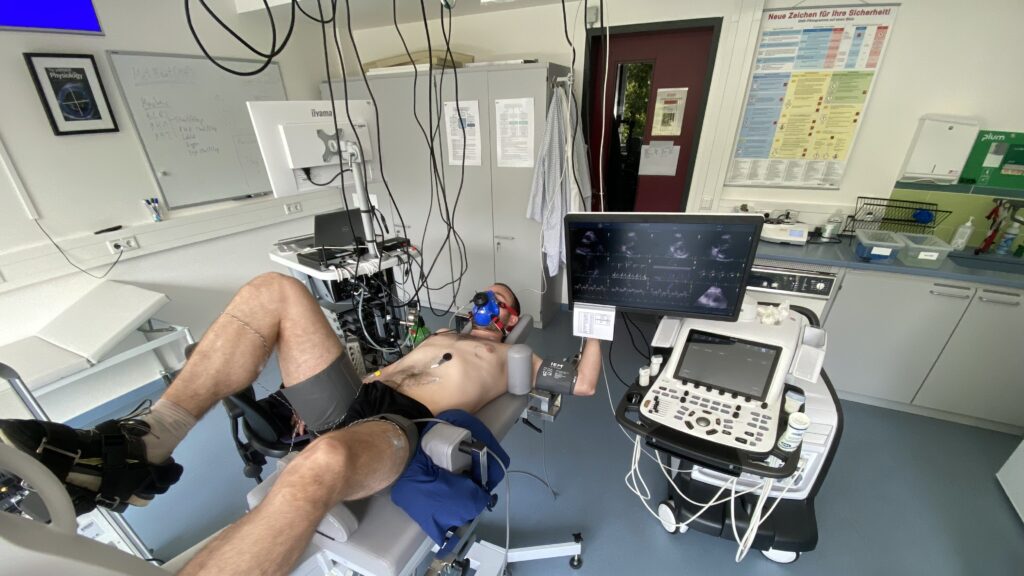
That’s why I also started the student research collective Y-HEART (Young investigators in Human Exercise And caRdiovascular Translational physiology) in mid 2025. The idea is similar: pass along knowledge and values that shape “good” research: thoughtfully executed, ethically reasonable, and methodologically valid.
I want to share my work process and its fallacies for several reasons:
(i) Science is a team sport.
That claim is backed by evidence: modern science increasingly depends on collaboration, and team structure shapes what kind of work gets produced. But your team should not only be the immediate people you work with. It’s the whole scientific community. Sharing successes, practical know-how, and mistakes can save others time, money, and frustration. And sometimes it prevents avoidable harm.
(ii) Academia needs more transparency.
There is a large and growing body of work on perverse incentives, reproducibility issues, and unhealthy power dynamics. And while a blog won’t solve systemic problems like power imbalance, bullying, mobbing, or sexual harassment, it can still contribute to a culture shift: more openness about processes, clearer norms, and a lower tolerance for “that’s just how it is.”
(iii) Writing is how I think.
This is something I really developed during my studies. I went from staring at blank pages to becoming a productive writer. Writing and research are mutually reinforcing: starting to write about a project often immediately improves it. Lab work and reading generate ideas. Not always good ones, but often worth capturing before they vanish. Writing adds structure, and that structure helps you see which ideas are worth pursuing – and which are better discarded.
Most posts will be short and structured: I’ll start with a question, summarize what I tried, share what surprised me and what I think it means, add one or two practical takeaways, and finish with a few references. My goal isn’t to be right on the first try but to be honest and to make progress and failure visible. Research is a process that can bring you down sometimes. By writing about my research process I will hopefully improve my ability to trust the process (great book by Shaun McNiff btw!).
And I’ll finish up with another book recommendation: A big inspiration and motivation for this blog was the book Share your work by Austin Kleon. Written for artists but useful for scientists, too.
If you’re still reading: welcome. See you soon!
Leave a Reply